


A Science-Based Guide for Pet Parents
The Leap of Faith: A Small Dog’s Daily Physics
You know the routine. Your twelve-pound shadow takes a running start, launches onto the couch, then launches right back off — twice their body height, over and over, all day long. Maybe they hesitate for a split second at the edge. Maybe they shake a hind leg afterward. Then they’re off again, tail going, as if gravity were merely a suggestion.
Here’s the paradox at the heart of small-dog ownership: the lower weight class does not mean a lower risk class. In some ways, it’s the opposite. A toy or small breed lives an extreme-sport lifestyle scaled to a frame that weighs less than a Thanksgiving turkey — jumping from proportionally greater heights, far more often, onto floors that don’t give an inch.
On a hard, unforgiving surface, the peak force of each landing reaches several times their body weight. The knees and hips absorb it. The cartilage compresses. And unlike muscle, cartilage has no blood supply of its own: it heals slowly, and often incompletely.
Which is why osteoarthritis and luxating patellas (slipping kneecaps) don’t wait for old age in small breeds. They often show up before middle age — frequently misread as “just a quirky little hop” until the pattern becomes impossible to ignore.
Why Are Small Joints So Vulnerable?
It isn’t one thing. It’s three forces working in combination — frequency, surface, and anatomy — and they compound each other beautifully (if you’re the arthritis) or tragically (if you’re the dog).
1. The High-Frequency Impact Loop
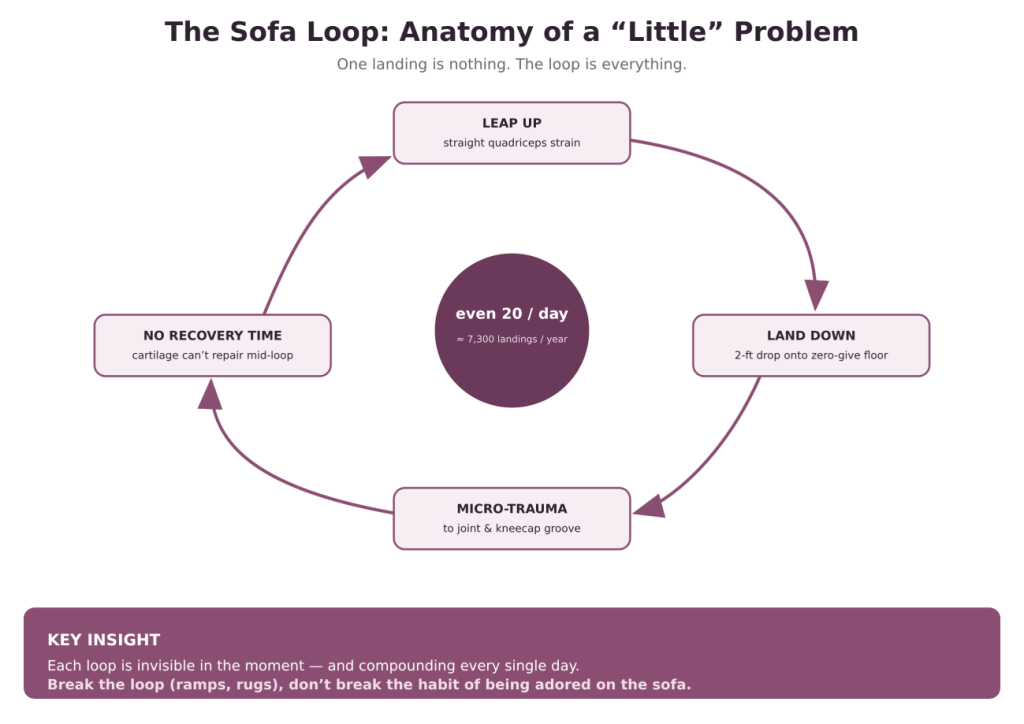
A single sofa jump is trivial. The loop is not. Small dogs don’t jump once; they jump dozens of times a day — onto the couch, off the couch, into your lap, out of the car, up the stairs, down the stairs. Each landing is a micro-trauma, and cartilage gets no rest days in between. The arithmetic is quietly brutal: even twenty jumps a day adds up to more than seven thousand landings a year.
The plain-English version: it’s not the fall that hurts them. It’s the landing — thousands of times a year.
2. The Surface Factor
Tile, hardwood, and laminate are the modern dog’s natural habitat — and they’re about as forgiving as concrete. Cartilage is viscoelastic: it cushions beautifully under gradual load but stiffens under sudden impact. A soft, grippy surface absorbs part of the shockwave. A hard one sends the whole thing straight up the leg, into joints roughly the diameter of a dime.
3. The Anatomical Predisposition
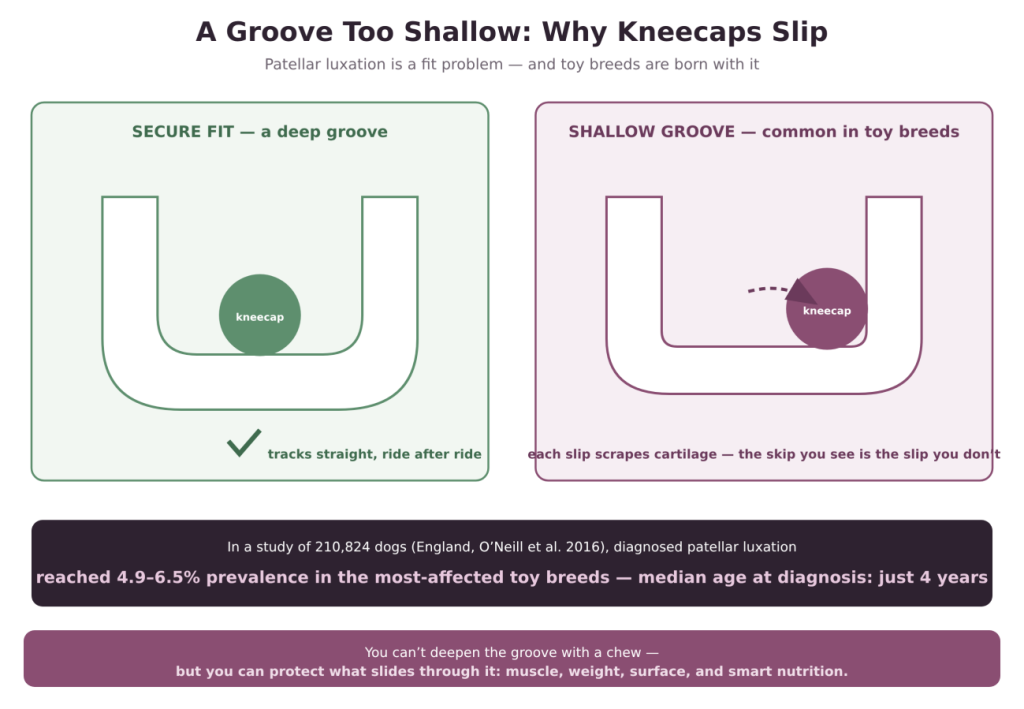
Many toy and small breeds are born with a shallow femoral groove — the channel at the end of the thigh bone that the kneecap rides in. When the groove is too shallow, the kneecap can slip sideways during movement. Every slip is a scrape against cartilage that was never designed to be scraped.
How common is this? In a study of 210,824 dogs attending primary-care practices in England (O’Neill et al., Canine Genetics and Epidemiology, 2016), diagnosed patellar luxation reached a prevalence of 4.9 to 6.5 percent in the most commonly affected toy breeds — roughly one in fifteen to one in twenty dogs — and the median age at first diagnosis was just four years old.
Building the Defense: What Actually Protects Small Joints
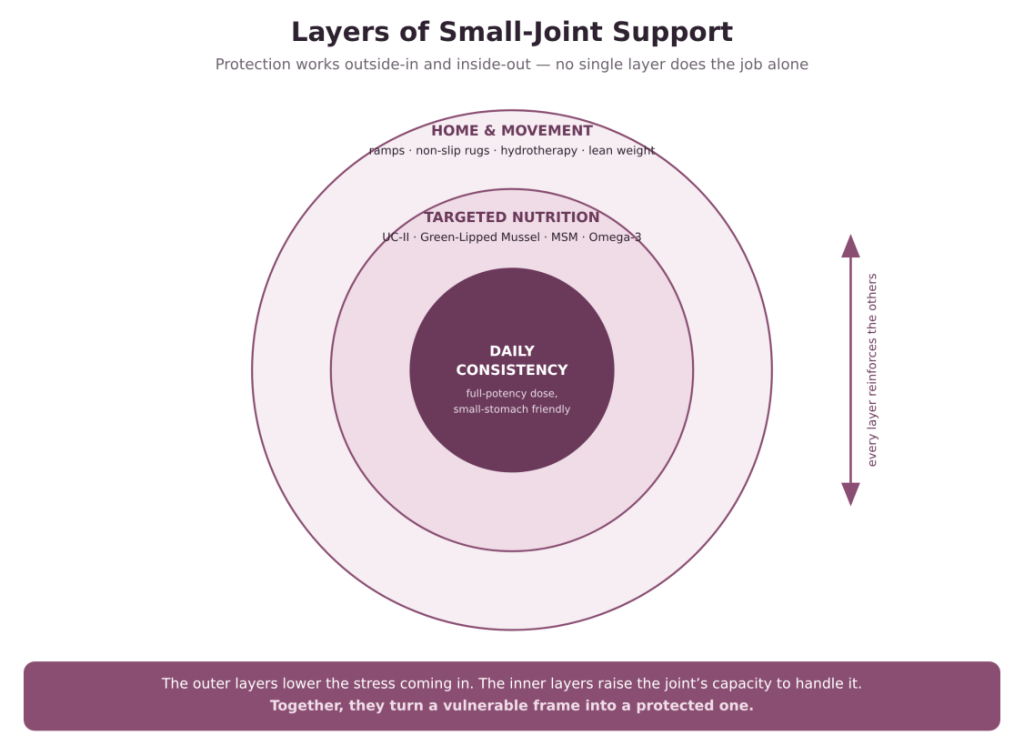
The encouraging news: small-dog joint risk is highly manageable, and the tools work in layers. The outer layers reduce the stress coming in; the inner layers raise the joint’s capacity to handle what gets through. You don’t need all of them perfect — you need most of them, most of the time.
1. Rethink the Landing Zone
You can’t stop a small dog from loving the sofa — and you shouldn’t try. The goal is to change what happens at the top and bottom of the leap.
Do this: Cover the landing strips. Place washable, high-density foam mats or non-slip rugs wherever your dog lands daily — beside the sofa, the bed, and at the base of stairs. You’re converting a zero-give surface into a shock absorber.
Do this: Install a ramp or pet stairs at the two or three favorite perches. Ramps convert vertical impact into horizontal motion — physics working for the joint instead of against it.
2. Hydrotherapy: Small Dog, Big Advantage
Water is the great equalizer for little joints. Buoyancy offloads the majority of a dog’s body weight, so a toy breed can build real hindquarter muscle — the muscle that helps stabilize a slipping kneecap — with a fraction of the compressive load of land exercise.
Protocol: 15–20 minutes of supervised swimming or underwater treadmill, three times a week, is plenty. Start shallow, keep sessions calm, and check with your vet first if your dog has any heart or respiratory issues — small breeds have small reserves.
3. Targeted Nutrition: Potency Over Volume
Here’s a constraint unique to the little guys: small dogs have small stomachs and a tight daily calorie budget. They physically cannot eat enough bulk food to deliver meaningful levels of joint-supporting nutrients from groceries alone. That’s the case for concentrated, high-potency supplementation — small doses, meaningful amounts.
The Ingredient Lineup: Four Compounds That Earn Their Keep
Not every trendy powder deserves space in that tiny daily calorie budget. These four have peer-reviewed evidence behind them — here’s what each one does, in plain English.
| Ingredient | What the research says | Plain-English version |
| UC-II (undenatured type II collagen) | Works through oral immune tolerance — it teaches the immune system to stop attacking the joint’s own cartilage rather than supplying raw building material. | Retrains the security guards instead of just repainting the walls. |
| Green-lipped mussel | Contains ETA, a rare omega-3 fatty acid that competes with arachidonic acid — the raw material inflammatory pathways use to build pain signals. | Cuts off the supply line to the inflammation factory. |
| MSM | A bioavailable sulfur donor. Sulfur is a structural component of the glycosaminoglycans that give cartilage its spring. | Delivers bricks to the cartilage construction site. |
| Omega-3 (EPA/DHA) | In controlled feeding studies, dietary EPA and DHA reduce production of IL-1 beta and TNF-alpha, two key inflammatory messengers in arthritic joints. | Turns down the volume on the joint’s alarm system. |
The UC-II evidence is worth a closer look, because it includes a head-to-head trial. In a randomized controlled trial of 60 dogs with osteoarthritis (Stabile et al., Veterinary Sciences, 2019), dogs receiving UC-II showed a 32.7% reduction in LOAD (Liverpool Osteoarthritis in Dogs) scores after just 30 days — comparable to the 31.5% reduction in dogs receiving robenacoxib, a prescription NSAID. Earlier controlled trials (Deparle et al., 2005; D’Altilio et al., 2007) found similar benefits on pain and mobility measures in arthritic dogs.
The honest footnote: supplements support joint comfort and function — they manage, they do not cure. A kneecap that sits permanently outside its groove is a surgical conversation, not a supplement conversation.
Dosing and Timeline: Small Dog, Small Numbers
Small breeds are actually the easy mode of joint supplementation — daily doses are tiny, affordable, and easy to hide in a teaspoon of food. Typical daily targets used by many veterinary-formulated products look like this:
| Body weight | Joint complex (per day) | Omega-3 EPA+DHA (per day) |
| Under 10 lbs | 250 mg | 100 mg |
| 10 – 20 lbs | 500 mg | 250 mg |
| 20 – 30 lbs | 750 mg | 350 mg |
These are general reference ranges, not prescriptions — formulations vary, so follow the label of your specific product and your vet’s guidance.
What to Expect, and When
Weeks 2-4: comfort-level changes tend to show first. Many owners report easier rising, less hesitation at the sofa, and a dog who stops doing the three-legged hop after naps.
Months 3-6: structural support accumulates. Cartilage nutrition and muscle stabilization are slow biology — think seasons, not days.
The right mindset is the thermostat, not the light switch: steady daily input, gradual response, no drama. Consistency beats enthusiasm.
Safety Notes: Boring on Purpose
Joint supplements have one of the best safety profiles in the pet aisle. The most common side effect is mild digestive adjustment — softer stool or a bit of gas during the first week — which usually resolves on its own.
Do this: Start at half the target dose for the first week, then step up. Tiny dogs, tiny transitions.
Do this: Check with your vet before starting if your dog is on NSAIDs or other medications, is pregnant, or has a shellfish allergy concern (relevant for green-lipped mussel products).
Questions Small-Dog People Actually Ask
Q: Can supplements fix my dog’s luxating patella?
A: No — and be cautious of anyone who says otherwise. Vets grade patellar luxation from I (occasional slip) to IV (permanently out of place). Mild grades are often managed successfully with weight control, muscle-building, and joint nutrition; severe grades need a surgical consult. The good news: many small dogs with mild grades live full, bouncy lives with conservative management.
Q: Should I just ban the couch?
A: Good luck with that. A ramp placed at the favorite perch works with your dog’s psychology instead of against it. For the first few days, lay a treat trail up the ramp — most small dogs adopt it quickly once they realize the view stays the same.
Q: Is swimming really safe for a five-pound dog?
A: Yes, with supervision and a properly fitted canine life vest. Start in shallow, warm water, keep sessions short, and never leave any dog unattended near water — tiny athletes tire fast.
The Bottom Line
Small dogs didn’t get the memo that they’re small. They leap, launch, and land like athletes four times their size, on joints a fraction of the size, for fifteen-plus years. The paradox of size is that the littlest dogs need the most deliberate joint protection — not because they’re fragile, but because they’re fearless.
The playbook is simple: soften the landings, build the muscle, feed the cartilage, and keep the routine boring enough to actually happen every day. Years from now, when your senior sidekick is still making it onto the couch (via the ramp, one hopes), you’ll know the plan worked.
Disclaimer: This article is for educational purposes only and is not a substitute for professional veterinary advice, diagnosis, or treatment. Always consult your veterinarian before starting any supplement, exercise, or weight-management program — especially for dogs with diagnosed joint conditions. (No small dogs were launched off sofas in the writing of this article. The sofa launches were all their own idea.)
Sources
O’Neill DG, et al. (2016). Epidemiology of patellar luxation in dogs attending primary-care veterinary practices in England. Canine Genetics and Epidemiology, 3:4.
Stabile M, et al. (2019). Evaluation of the effects of undenatured type II collagen (UC-II) as compared to robenacoxib on the mobility impairment induced by osteoarthritis in dogs. Veterinary Sciences, 6(3):72.
Deparle LA, et al. (2005). Efficacy and safety of glycosylated undenatured type-II collagen (UC-II) in therapy of arthritic dogs. Journal of Veterinary Pharmacology and Therapeutics, 28(4):385-390.
D’Altilio M, et al. (2007). Therapeutic efficacy and safety of undenatured type II collagen singly or in combination with glucosamine and chondroitin in arthritic dogs. Toxicology Mechanisms and Methods, 17(4):189-196.