


A Science-Based Guide for Pet Parents
The Silent Strain of Giants
If you share your home with a Golden Retriever, a German Shepherd, a Labrador, a Newfoundland, or a Great Dane, you already know the sound: the whole-house thud when ninety pounds of enthusiasm launches off the back deck and hits the ground running. A Chihuahua making the same leap barely bends the grass. Your dog lands like a dropped sandbag — and their joints absorb every pound of it.
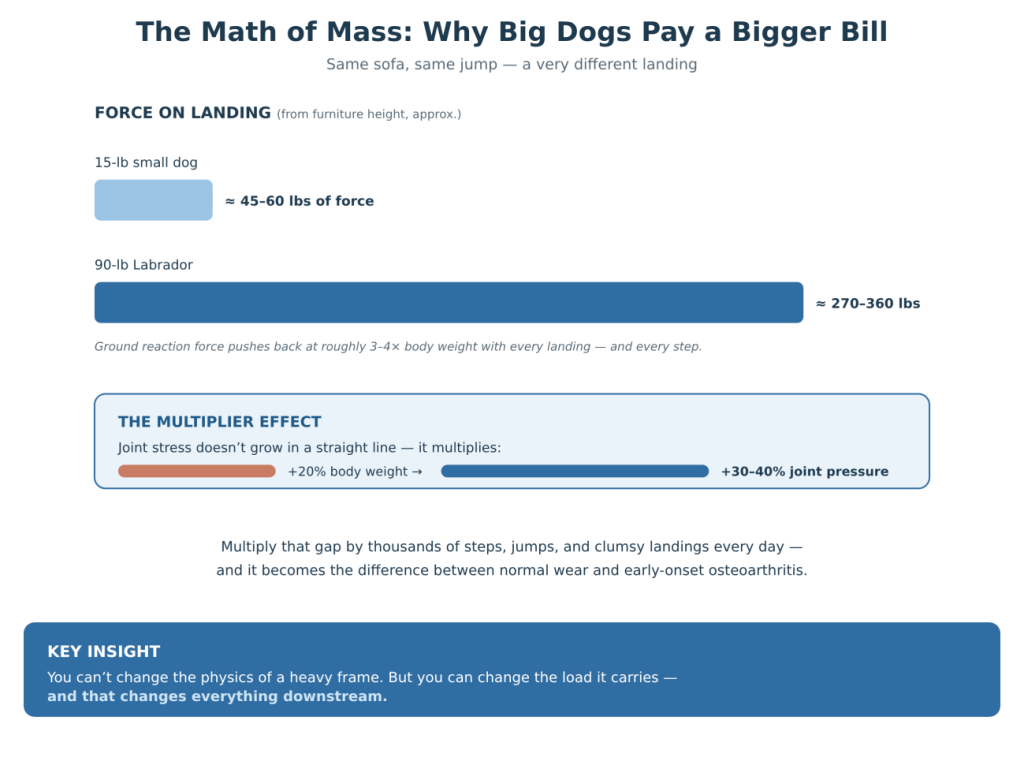
Veterinary researchers sometimes call this the “structural paradox” of large breeds: the same body mass that makes them powerful also puts them at a biomechanical disadvantage that smaller dogs simply never face. When a 90-pound Labrador lands from a jump, the ground pushes back with a force of roughly three to four times their body weight. Multiply that by thousands of steps, jumps, and sloppy landings every single day, and you begin to see why cumulative load — not bad luck — is what so often drives early-onset osteoarthritis and cranial cruciate ligament (CCL) tears in big dogs, sometimes in animals that look like the picture of health.
And if you want to see what a difference the load itself makes, look at the most remarkable feeding study in canine history. In a 14-year lifetime study of 48 Labrador Retrievers (Kealy et al., Journal of the American Veterinary Medical Association, 2002), dogs fed about 25% fewer calories stayed lean, showed the first radiographic signs of hip osteoarthritis about six years later than their full-fed littermates, and lived a median of 1.8 years longer. Same breed. Same genes. Different load on the frame — dramatically different joints.
The lesson is oddly hopeful: the burden is real, but it is manageable.
Why Does Size Matter So Much?
1. The Force Multiplier Effect
Joint stress doesn’t scale in a straight line — it multiplies. A commonly cited biomechanical estimate holds that a 20% increase in body weight can translate into a 30–40% increase in joint pressure. For a large breed, carrying extra weight is not a cosmetic issue; it is a daily mechanical assault on the hips and knees.
The plain-English version: on a big frame, every pound shows up to the joint wearing work boots.
“It may sound simple, but the fact is that over 50% of the dogs we see are overweight. And that puts undue stress on their joints and soft tissue.”
— Dr. Felix Duerr, DVM, DACVS-SA, DACVSMR, Associate Professor of Small Animal Orthopedics, Colorado State University, interview: “Canine Mobility: Factors Affecting a Dog’s Ability to Move,” Platinum Performance, 2025
2. The Growth Plate Window
Large breeds grow fast — and that speed is precisely the risk. For the first 12 to 18 months of life, their growth plates (the soft, cartilage-rich zones at the ends of the long bones) remain open. If nutrition overshoots — too many calories, or excessive calcium — bones can lengthen faster than the muscles and ligaments around them can adapt, producing joint instability and developmental dysplasia.
This is not theory. In a prospective cohort study of 501 large-breed puppies in Norway (Krontveit et al., American Journal of Veterinary Research, 2012), puppies who regularly climbed stairs before three months of age had a measurably increased risk of hip dysplasia, while off-leash exercise on soft, varied ground was associated with a lower risk. For a growing giant, the environment in the first months matters as much as the menu.
3. The Sedentary Giant Trap
Here’s the paradox that catches well-meaning owners: worried about those big joints, they cut back on exercise. But muscles are the body’s primary shock absorbers, and an under-exercised giant slowly loses the very muscle mass that protects the cartilage. Less muscle means more load transferred straight onto the joint — which accelerates wear, which makes movement less comfortable, which tempts owners to restrict activity even further.
It’s an understandable instinct, and a completely backwards strategy. The goal was never less movement — it’s better-chosen movement.
What Actually Helps?
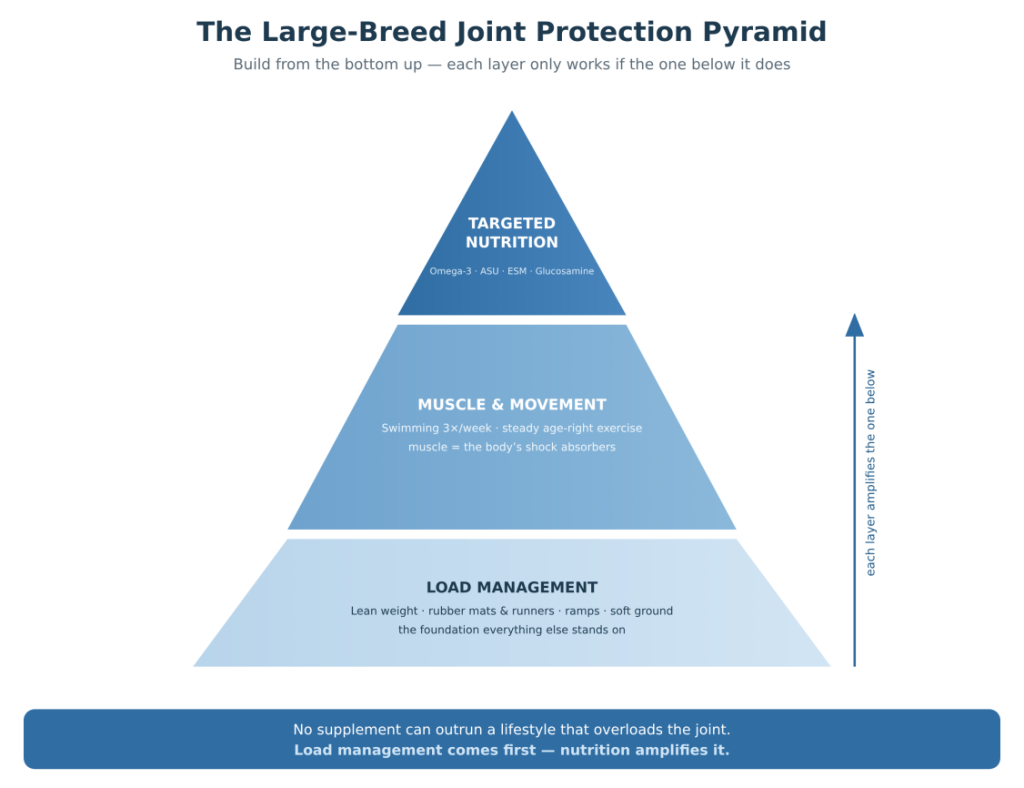
Protecting a large breed isn’t one decision; it’s a system. The components that matter most are load management (how hard the joint works) and tissue support (what the joint is made of). Let’s take them in turn.
1. Hydrotherapy: The Gold Standard
If there is one form of exercise tailor-made for a heavy frame, it’s swimming. The buoyancy of water supports up to 90% of a dog’s body weight, allowing full range of motion and genuine muscle building with virtually no compressive joint loading. All of the workout, almost none of the impact.
Protocol: 20–30 minutes of swimming, three times per week, is enough to build hindquarter muscle without pounding the joints. A canine hydrotherapy pool or a calm, easy-entry lake beats a slip-and-scramble riverbank every time.
2. Surface Management
Concrete and tile offer zero shock absorption and zero grip — a bad combination under ninety pounds.
Do this: Install high-density rubber mats or non-slip runners in high-traffic areas — the route to the back door, the kitchen, anywhere your dog regularly changes speed or direction.
Do this: Use a ramp for car entry and furniture access. Every avoided leap off the tailgate is one less vertical impact on joints that are already doing heavy work.
The Nutrition Foundation: Feeding the Frame
A large skeleton is a large construction project, and it runs on specific raw materials. This is where targeted nutrition earns its place — not as a magic fix, but as structural support for a frame that never stops carrying weight. Here’s what the main ingredients actually do:
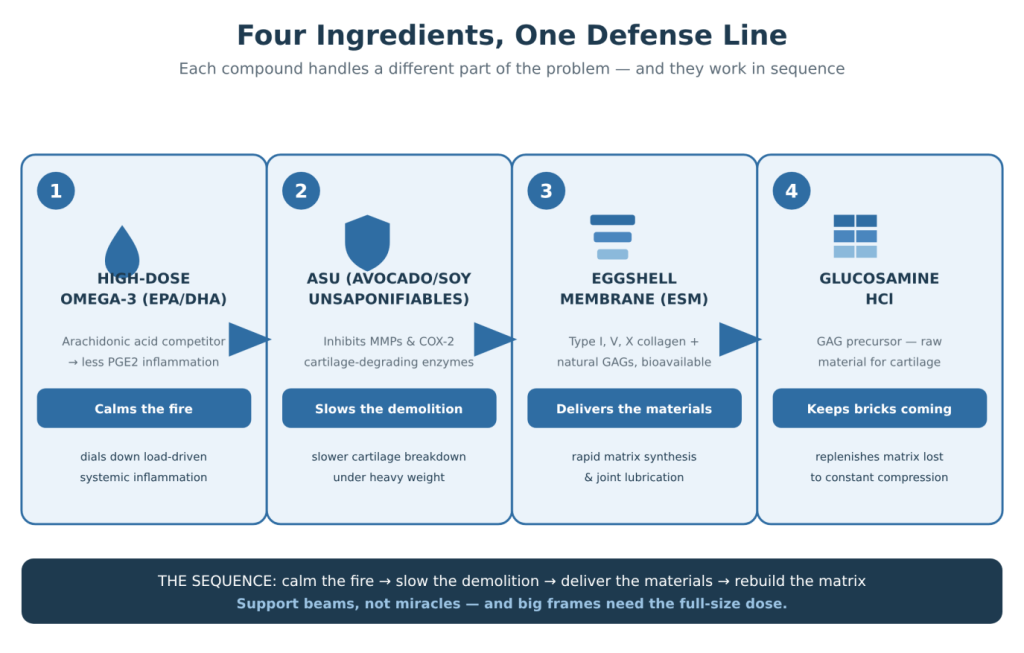
The plain-English version: Omega-3s calm the fire, ASU slows the demolition crew, eggshell membrane delivers pre-fabricated building materials, and glucosamine keeps the brick supply coming.
What does the evidence actually say? Both sides deserve a hearing. In a 2016 multicenter, randomized, placebo-controlled study in dogs with suboptimal joint function (Ruff et al., Veterinary Medicine: Research and Reports), owners reported a mean 19.4% improvement in pain scores after just one week of eggshell membrane supplementation — a genuinely encouraging, rapid result. At the same time, intellectual honesty demands the full picture: for the older glucosamine–chondroitin combination, a systematic review of canine osteoarthritis trials rated the evidence as only moderately convincing.
“The lack of response and the limited number of controlled trials make it difficult to formulate any recommendations at this time.”
— Aragon CL, Hofmeister EH, Budsberg SC. “Systematic review of clinical trials of treatments for osteoarthritis in dogs.” Journal of the American Veterinary Medical Association, 2007;230(4):514–521
Translation: these ingredients are biologically plausible and widely used, the newer ones are building promising trial data — and none of them are magic. Support beams, not miracles.
One more practical point, and it’s a big one for big dogs: efficacy is dose-dependent. Clinical experience suggests a minimum of around 1000 mg of glucosamine daily for dogs over 70 lbs to reach meaningful tissue concentrations. A toy-sized dose in a Mastiff is a rounding error.
Dosage Guidelines for Large Breeds
Because large breeds vary so much in mass, getting the amount right matters as much as getting the ingredient right. The following are general daily targets for healthy large-breed adults — always confirm with your veterinarian before starting.
| Weight Range | Daily Glucosamine Target | Daily Chondroitin Target |
| 50 – 70 lbs | 750 mg | 350 mg |
| 70 – 90 lbs | 1000 mg | 500 mg |
| Over 90 lbs | 1200 – 1500 mg | 600 – 750 mg |
Consistency is key: structural change in cartilage is slow by nature. Expect 8–12 weeks of consistent daily supplementation before judging improvements in mobility and stiffness — and if nothing has changed after a fair trial, that’s useful information to take back to your vet, not a reason to double the dose on your own.
Safety & Side Effects
Joint supplements have a reassuring safety record, but “natural” is not a synonym for “risk-free” — and a 90-pound dog eats a 90-pound dose of everything, including mistakes.
Mild adaptation: Some dogs develop soft stools during the first week as their digestive system adjusts. This usually resolves on its own; if it lasts more than a few days or seems uncomfortable, pause and call your vet.
Interactions and individual variation: Most joint ingredients coexist peacefully with common medications, but “most” isn’t “all.” If your dog takes prescription medication — or has a diagnosed condition — your vet needs to know about everything they’re getting, supplements included.
And one honest caveat that belongs in every large-breed conversation: no supplement can outrun a lifestyle that overloads the joint. If a big dog is carrying extra weight and launching off the tailgate every day, the supplement is fighting a battle the daily routine keeps losing. Load management comes first; nutrition amplifies it.
Frequently Asked Questions
Q: Is swimming really better than walking?
A: For dogs with existing joint pain, yes. Walking on hard surfaces still imposes compressive loads with every step; swimming eliminates them almost entirely while building the muscle that protects the joint long-term. For a healthy young giant, walking on grass is still a fine everyday option — think of swimming as the upgrade, not the requirement.
Q: Can I just feed fish oil?
A: Fish oil earns its reputation — EPA and DHA are among the best-supported anti-inflammatory nutrients we have. But it brings no structural precursors (glucosamine, chondroitin, collagen) to the construction site. For a large breed carrying real mechanical load, a comprehensive formula is the more complete tool: fish oil manages the inflammation, but the frame needs building materials too.
The Bottom Line
Big dogs pay a bigger bill — there’s no getting around the physics. Every extra pound, every hard landing, every pound of lost muscle compounds quietly on a frame that was never going to have an easy job. But the same physics works in your favor: keep the weight lean, choose water over pavement, soften the landings, and feed the frame what it’s actually made of, and the burden shrinks to something a happy, athletic giant can carry comfortably for years.
Your dog will still land like a dropped sandbag. The goal is simply to make sure the landing gear was built for it.
Disclaimer: This article is for informational purposes only and does not constitute medical advice. Every pet is a unique individual. Always consult with your veterinarian before making decisions about your pet’s health, and use your best judgment (about both your pet’s joints and their specific dietary needs).
Sources
- Kealy, R.D., Lawler, D.F., Ballam, J.M., et al. (2002). Effects of diet restriction on life span and age-related changes in dogs. Journal of the American Veterinary Medical Association, 220(9), 1315–1320.
- Krontveit, R.I., Nødtvedt, A., Sævik, B.K., Ropstad, E., & Trangerud, C. (2012). Housing- and exercise-related risk factors associated with the development of hip dysplasia as determined by radiographic evaluation in a prospective cohort of Newfoundlands and Labrador Retrievers in Norway. American Journal of Veterinary Research, 73(6), 838–846.
- Duerr, F. (2025). Interview: “Canine Mobility: Factors Affecting a Dog’s Ability to Move,” Platinum Performance.
- Ruff, K.J., et al. (2016). Effectiveness of NEM brand eggshell membrane in the treatment of suboptimal joint function in dogs: a multicenter, randomized, double-blind, placebo-controlled study. Veterinary Medicine: Research and Reports, 7, 113–121.
- Aragon, C.L., Hofmeister, E.H., & Budsberg, S.C. (2007). Systematic review of clinical trials of treatments for osteoarthritis in dogs. Journal of the American Veterinary Medical Association, 230(4), 514–521.