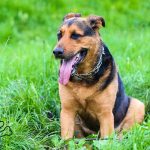


A healthy four-to-eight-year-old is not a reason to skip joint care. It’s the reason joint care works.
PART I: WHY — The Silent Wear
Cartilage has no blood supply and almost no nerves. By the time a limp is obvious, the damage is rarely new.
The 48-Dog Lesson
Kealy et al. (JAVMA, 2002) followed 48 Labrador retrievers for life. Half ate standard rations; half ate 25% less from puppyhood.
| CONTROL GROUP (Standard Ration) | LEAN-FED GROUP (25% Less Calories) |
| Hip OA by Age 8: 68% | Hip OA by Age 8: 14% |
| Median Lifespan: 11.2 years | Median Lifespan: 13.0 years |
| Treatment needed: Earlier | Treatment needed: ~3 years later |
The lesson: The most powerful joint intervention ever tested in dogs was not a drug or supplement. It was maintenance — started early, kept up for life.
The Economics of Maintenance
| PREVENTION (Daily) | SURGERY (One-Time) |
| Daily supplement: <$1/day | TPLO surgery: $3,000–$6,000 |
| Weight management: Free | Total hip replacement: $6,000–$15,000 |
The honest framing: Maintenance lowers the odds and softens the impact. It does not make any dog bulletproof — and anyone who promises otherwise is selling something.
PART II: The Four Pillars of Maintenance
Joint care isn’t one product or one habit — it’s four supports that share the load.
| PILLAR 1 WEIGHT The First Lever “Over 50% of dogs we see are overweight. That puts undue stress on joints.” — Dr. Felix Duerr, DVM, DACVS Sports Medicine & Rehabilitation | PILLAR 2 MOVEMENT Daily, Steady, Low-Impact • Muscle = joint’s external shock absorber • Weekend warrior = spike loading • Trade marathon fetch for two shorter walks • Swimming: full workout, fraction of impact |
| PILLAR 3 HOME Engineer the Landings • Ramps at favorite perches • Rugs on slick surfaces • Orthopedic beds that don’t bottom out • Convert vertical impact → horizontal motion | PILLAR 4 NUTRITION Targeted Support, Honestly Graded • UC-II: Oral immune tolerance • Green-lipped mussel: ETA omega-3 • MSM: Bioavailable sulfur donor • Omega-3 EPA/DHA: Inflammatory modulation |
Pillar 4 Deep Dive: The Ingredients
| Ingredient | Mechanism | Evidence Level |
| UC-II (undenatured type II collagen) | Oral immune tolerance — teaches immune system to stop attacking joint cartilage | Strong: Stabile et al. (2019) — 32.7% LOAD reduction in 30 days, comparable to robenacoxib (NSAID) |
| Green-lipped mussel | Contains ETA, rare omega-3 that competes with arachidonic acid — blocks inflammatory pathway raw material | Moderate: Aragon et al. (2007) JAVMA systematic review |
| MSM | Bioavailable sulfur donor — structural component of glycosaminoglycans that give cartilage spring | Moderate: Limited RCTs; strong community endorsement |
| Omega-3 (EPA/DHA) | Reduces IL-1 beta and TNF-alpha production — key inflammatory messengers in arthritic joints | Strong: Multiple controlled feeding studies (Roush et al., 2010; Fritsch et al., 2010) |
Evidence grading: Aragon, Hofmeister & Budsberg (2007) JAVMA systematic review of 16 clinical trials — prescription NSAIDs (meloxicam) rated strongest; green-lipped mussel and glucosamine-chondroitin earned “moderate level of comfort.” UC-II backed by newer controlled trials (Stabile 2019; Deparle 2005; D’Altilio 2007).
PART III: When Prevention Meets Surgery
Sometimes structure and bad luck win a round. What matters is what happens next.
The Other Leg: A Statistical Reality
Muir et al. (PLoS ONE, 2011) studied 380 dogs with unilateral CCL rupture:
| 54% Contralateral CCL tear within median 2.6 years | 22-54% Reported range across studies | 100% Risk reduction potential with weight management |
Why both knees? Mechanical: the sound leg carries double duty through recovery. Biological: the same degenerative process often affects both knees.
The 12-Week Recovery Playbook
| WEEKS 0-2: REST & PROTECT • Crate rest, cone stays on • Pain managed exactly as prescribed • Appetite dips — high-potency nutrition in small servings |
▼
| WEEKS 3-8: CONTROLLED MOVEMENT • Short leash walks on schedule • Frozen Kongs and puzzle feeders for mental energy • Rugs over every slick floor • Watch the scale — activity dropped by half, calories must match |
▼
| WEEKS 8-12+: REBUILD & RELOAD • Walks lengthen gradually • Hydrotherapy rebuilds hindquarter muscle at minimal joint cost • Four pillars become permanent residents, not temporary guests |
PART IV: Questions Adult-Dog People Actually Ask
| Q: My dog is four and perfectly healthy — isn’t this a waste of money? |
| A: The 48-dog lifetime study showed maintenance started early was the single most powerful joint intervention ever tested. The honest caveat: the first lever is your dog’s waistline, not a bottle. Supplements are pillar four of four — valuable, but they work best standing on the other three. |
| Q: How will I know if anything is actually working? |
| A: Run the 4-6 week check-in: one line a week on morning rise speed, couch hesitation, post-nap stiffness, and play initiation. You’re watching trends, not days. If nothing has shifted by week six, bring your notes to your vet — that diary is genuinely useful clinical information. |
| Q: We’re already post-TPLO. Did we miss the window? |
| A: No — you just moved to the second battlefield. Recovery is when joint care has the highest stakes: nutrition supports healing, weight control protects the other leg, and muscle rebuilding determines how the next decade goes. Start the pillars now and keep them. |
| Q: So how long does this routine last? |
| A: Joint care isn’t a course of treatment; it’s a lifestyle with chapters. The goalposts shift — prevention in mid-life, comfort management in the senior years — but the principles don’t. Lean, steady, soft-landed, well-fed: that’s true at four, at eight, and at fourteen. |
The Bottom Line
| At 4-8 years, you’re not paying for today’s joints |
▼
| You’re paying for every morning, ten years from now when your senior dog gets up without a second thought |
▼
| The formula: Lean + Steady + Soft-Landed + Well-Fed = Extra good years together |
Disclaimer: This article is for educational purposes only and is not a substitute for professional veterinary advice, diagnosis, or treatment. Always consult your veterinarian before starting any supplement, exercise, or weight-management program — especially before and after any surgical procedure.
Sources
1.Kealy RD, et al. (2002). Effects of diet restriction on life span and age-related changes in dogs. JAVMA, 220(9):1315-1320.
2.Muir P, et al. (2011). Contralateral cruciate survival in dogs with unilateral non-contact cranial cruciate ligament rupture. PLoS ONE, 6(10):e25331.
3.Aragon CL, Hofmeister EH, Budsberg SC (2007). Systematic review of clinical trials of treatments for osteoarthritis in dogs. JAVMA, 230(4):514-521.
4.Stabile M, et al. (2019). Evaluation of the effects of undenatured type II collagen (UC-II) as compared to robenacoxib on the mobility impairment induced by osteoarthritis in dogs. Veterinary Sciences, 6(3):72.
5.Deparle LA, et al. (2005). Efficacy and safety of glycosylated undenatured type-II collagen (UC-II) in therapy of arthritic dogs. J Vet Pharmacol Ther, 28(4):385-390.
6.D’Altilio M, et al. (2007). Therapeutic efficacy and safety of undenatured type II collagen singly or in combination with glucosamine and chondroitin in arthritic dogs. Toxicol Mech Methods, 17(4):189-196.
7.Platinum Performance (2025). Canine Mobility: Factors Affecting a Dog’s Ability to Move — interview with Dr. Felix Duerr.