

By Elizabeth Kennedy, Pet Nutrition Science Content Specialist
The Shift: When the Leap Becomes a Look
You know the routine has changed. The dog who once launched onto the sofa with a single, confident bound now pauses at the edge. They look at you, then at the cushion, waiting for a pat or a gentle nudge before making the climb. The sharp click-clack of nails on hardwood has slowed to a softer shuffle. Getting up from a nap isn’t a spring-loaded action anymore; it’s a process — a quiet groan, a long stretch, a careful testing of the legs.
The walk hasn’t necessarily gotten shorter, but the pace has. It’s no longer about distance; it’s about the sniff. Every fire hydrant is a news report, every patch of grass a story to be read slowly.
And in every owner community we listen to, the same two sentences keep appearing. First, the heartbreak: “She whimpers when she changes positions, and it’s breaking my heart.” Then the plea: “What actually helped your senior dog with arthritis?”
Which brings us to the real question of this life stage: is it too late to start joint care at eight and up — and if we start, what are we actually trying to achieve?
The answer to the first is no, it is not too late. But the answer to the second matters more: the goal has changed. We are no longer playing to prevent, and we are not playing to reverse. We are playing for comfort — for today’s quality of life. We aren’t buying a cure; we’re buying extra good years together.
From Prevention to Comfort: A Goal Shift
In the four-to-eight-year window, joint care protects the future flexibility of a dog who is still athletic. At eight and beyond, the mission shifts to managing the present — and that shift is honest biology, not surrender. Cartilage has no blood supply and heals slowly even in youth; once structural damage is done, we cannot rebuild the original architecture. As one owner in a senior-dog community put it, with unusual clarity: “No supplement can repair any damage, but it does seem to help masses.”
What we can do is change the environment around the joint: reduce the inflammation it bathes in, support the tissue that remains, and take load off the system. Done consistently, that changes how every single day feels.
Why Senior Joints Hurt More: The Science Behind the Discomfort
Why does discomfort seem to accelerate in the senior years? Rarely one thing — usually three, compounding:
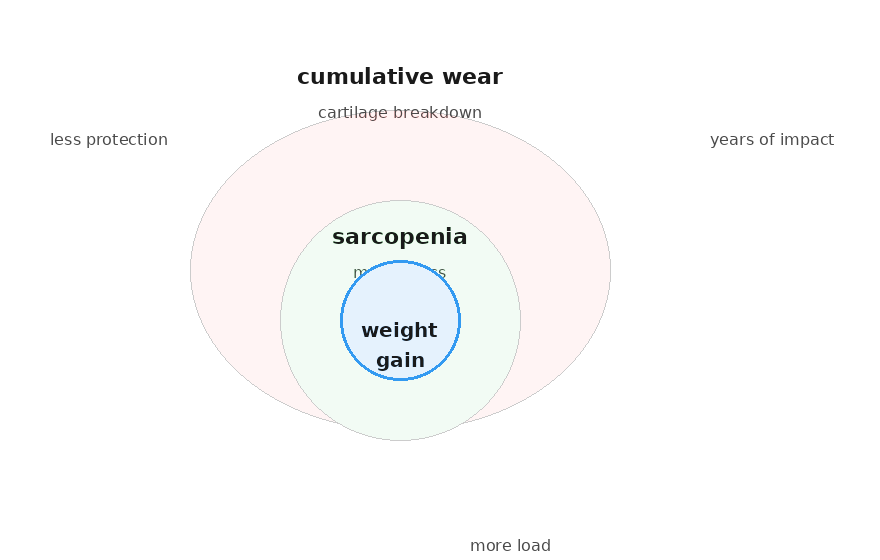
The hopeful part: a spiral that is fed by three links can be broken at any one of them.
The Multimodal Approach: No Single Solution
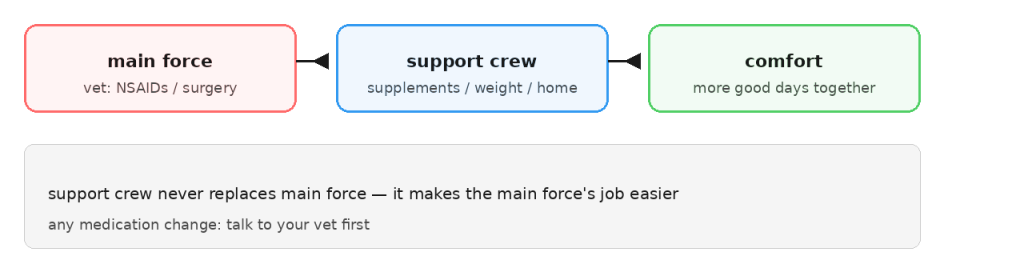
Think of it as a relay. The Main Force — your veterinarian’s toolkit, from NSAIDs to surgery — delivers fast, decisive control of pain and inflammation. The Support Crew — supplements, weight, environment — runs the long daily leg that keeps comfort stable between vet visits. The Support Crew never replaces the Main Force; it makes the Main Force’s job easier. And one rule is worth remembering: any change to medication, in either direction, is a conversation best had with your vet.
The Senior Four Pillars: Adapted for the Golden Years
The four pillars of joint care don’t retire — they adapt. Here’s the senior edition:
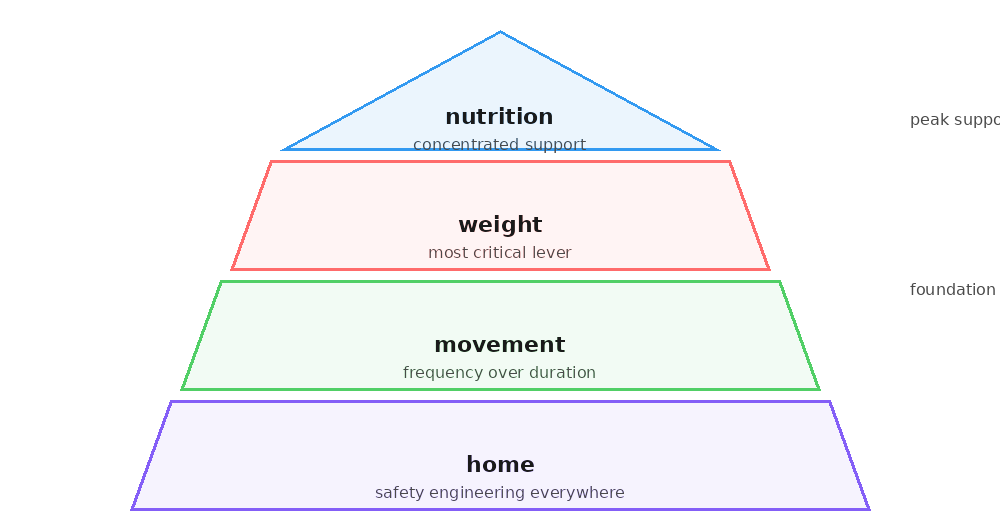
“Care first” has one meaning at this age: it is never too late to start — and starting today may beat starting tomorrow.
The Support Crew: Key Ingredients That May Help Ease Discomfort
Supplements earn their place on the senior care team through distinct pathways. Here’s what each one does — and, just as important, what the evidence suggests.
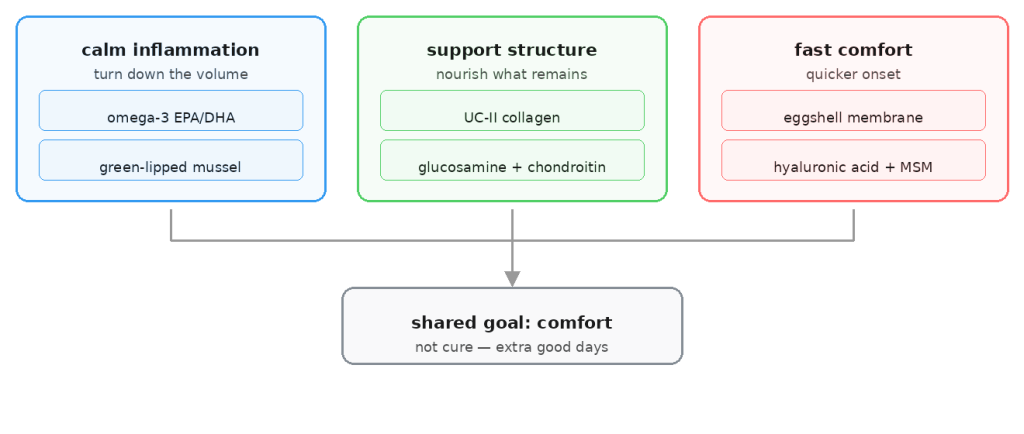
1. Calming Inflammation — Turning Down the Volume
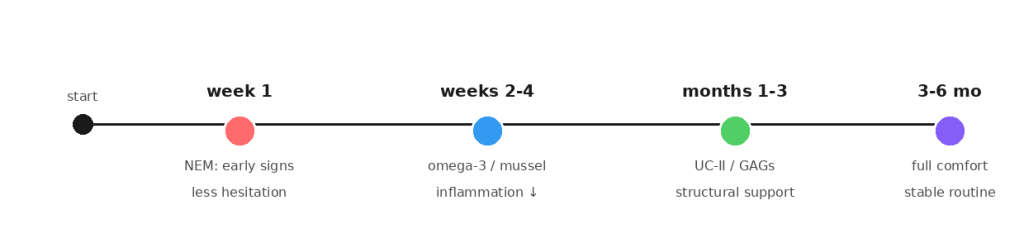
Omega-3 Fatty Acids (EPA & DHA). Found in fish oil and marine sources, EPA and DHA are long-chain polyunsaturated fatty acids that compete with arachidonic acid — the precursor to pro-inflammatory eicosanoids. In a controlled, force-plate study (Roush et al., JAVMA, 2010), dogs fed a diet high in fish oil showed improved weight-bearing on arthritic limbs. EPA and DHA appear to dial down production of IL-1 beta and TNF-alpha, two key inflammatory cytokines.
Green-Lipped Mussel (Perna canaliculus). This New Zealand shellfish contains a unique omega-3 called eicosatetraenoic acid (ETA), which appears to compete with arachidonic acid at the COX and LOX enzyme level — essentially cutting off the supply line to inflammatory mediators before they form.
2. Supporting What Remains — Cartilage & Connective Tissue
UC-II (Undenatured Type II Collagen). Unlike hydrolyzed collagen, UC-II maintains its native triple-helix structure. It works through oral tolerance: small doses pass through the gut-associated lymphoid tissue and appear to signal the immune system to reduce autoimmune-like attacks on the joint’s own cartilage. In a randomized controlled trial of 60 dogs (Stabile et al., Veterinary Sciences, 2019), UC-II reduced LOAD pain-and-function scores by 32.7% after 30 days — comparable to the 31.5% reduction in dogs receiving robenacoxib, a prescription NSAID.
Glucosamine & Chondroitin Sulfate. These are the building blocks of glycosaminoglycans (GAGs), the water-attracting molecules that give cartilage its resilience. Glucosamine provides the amino sugar backbone, while chondroitin sulfate provides the sulfated disaccharide chains that resist compressive forces. Together, they aim to support the remaining cartilage matrix — not rebuild what’s gone, but nourish what remains.
3. Fast Comfort — Ingredients with Quicker Onset
Eggshell Membrane (NEM). A thin layer between the eggshell and the egg white, this natural matrix contains collagen (Types I, V, and X), elastin, hyaluronic acid, and glycosaminoglycans. In a 51-dog, multicenter, placebo-controlled trial (Ruff et al., 2016), supplemented dogs showed 19.4% greater improvement in owner-scored pain than placebo in just one week — and by six weeks, quality-of-life scores were up 26.8%.
Hyaluronic Acid (HA). A major component of synovial fluid and cartilage extracellular matrix, HA provides viscosity and lubrication to joints. Oral forms aim to support the body’s own HA synthesis.
MSM (Methylsulfonylmethane). An organic sulfur compound that provides bioavailable sulfur — essential for collagen and cartilage matrix formation. MSM also appears to have mild anti-inflammatory properties.
How Solid Is the Evidence, Honestly?
A systematic review in the Journal of the American Veterinary Medical Association (Aragon, Hofmeister & Budsberg, 2007) graded sixteen clinical trials of canine osteoarthritis treatments. The strongest evidence belonged to prescription NSAIDs such as meloxicam; green-lipped mussel and glucosamine-chondroitin combinations earned a “moderate level of comfort” — the authors’ term for promising but not yet definitive. That grading is exactly why we position supplements as the Support Crew: genuinely useful, honestly bounded, and never a stand-in for veterinary care.
More recent trials (Ruff 2016 on NEM; Stabile 2019 on UC-II) have added to the evidence base, but the field still calls for larger, longer studies. The honest takeaway: these ingredients may help many dogs, but they won’t help every dog, and they won’t replace veterinary treatment.
What Relief May Look Like in Daily Life
Supplements won’t make a twelve-year-old dog run like a puppy — and anyone who promises that is selling fiction. What they may deliver is more valuable in daily life: less hesitation when standing up; less waiting to be carried up the stairs; morning stiffness that shrinks from ten minutes to two; the return of the toy dropped hopefully at your feet.
Palatability tip: many seniors get picky. If big chews get refused, switch the delivery, not the ingredients — powders stirred into warm wet food, liquids, or small tablets hidden in a treat. If they won’t eat it, it can’t work.
Teaming Up With Your Vet
Supplements do their best work inside a veterinary plan — and you can make that plan better with a few things in hand:
Bring notes. A joint diary (two to four weeks of observations), a list of every supplement and dose your dog currently takes, and your observations on four daily markers: rising, walking, stairs, and play.
Ask good questions. What is my dog’s current pain score, and is it controlled? Could these supplements interact with current medications, including NSAIDs? Is this the right time to discuss injectable therapies or physical rehabilitation?
A note on newer therapies: options such as monoclonal antibody injections have generated both enthusiastic reports and documented side-effect concerns. Neither the cheerleaders nor the alarmists own this decision — your vet does, armed with your dog’s full history: liver, kidney, heart, and every medication on board. Ask your questions, and decide together.
The Daily Comfort Loop: Observe, Adjust, Repeat
Building a routine around your senior dog’s joint comfort is an ongoing cycle — not a one-time setup. Here’s how the pieces fit together:
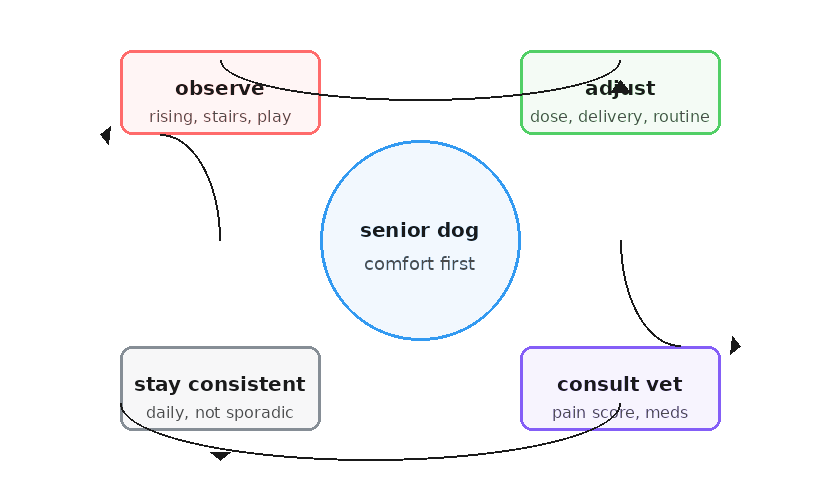
Observe your dog’s daily markers — how they rise from rest, handle stairs, and engage with play. Adjust supplement delivery, dosage timing, or exercise routines based on what you see. Consult your vet when patterns change or pain signals increase. Stay consistent — sporadic efforts yield sporadic results, while daily habits build cumulative comfort.
Senior Surgery and Recovery
Age alone is not a contraindication for surgery. Plenty of dogs over twelve successfully undergo orthopedic procedures — what changes is the preparation and the pace. Pre-operative screening (blood work, often cardiac evaluation) matters more, because anesthesia planning depends on it. Healing runs slower, so every timeline stretches. And the recovery setup deserves thought: strict crate rest can be genuinely stressful for an old dog, and a quiet, small-room setup with an orthopedic bed often keeps everyone calmer and safer.
Two priorities carry the whole recovery: strict weight control (senior metabolism gains fast when activity drops) and low-impact rebuilding — hydrotherapy is the senior athlete’s gym. Through it all, nutrition plays its supporting role again: high-quality protein to rebuild muscle, joint nutrients to supply repair materials, in servings a convalescing appetite can actually finish.
Questions Senior-Dog People Actually Ask
Q: My dog is twelve. Is it really worth starting supplements now?
A: Yes — because the goal is different now. You’re not buying prevention; you’re buying comfort, and comfort ingredients act on a timeline of days to weeks, not years. In the eggshell membrane trial, meaningful pain improvement showed up in one week — in a study whose dogs ranged up to fourteen years old. UC-II showed measurable improvement in thirty days. For a senior dog, those weeks are the whole point.
Q: Can supplements replace pain medication?
A: No — and please be wary of any source that says otherwise. Supplements support the terrain: inflammation levels, cartilage nutrition, muscle. Prescription medication controls acute pain. They do different jobs on the same team, and any change to medication dosing is a conversation for your vet, never a solo decision.
Q: I’ve read worrying things about side effects of newer injections. What should I do?
A: Every effective treatment carries risk, and the honest answer is: it depends on your dog. Liver and kidney values, current medications, and overall health all shape the risk-benefit math — which is precisely why this decision belongs in the exam room, not in a comment thread. Track any new therapy with your joint diary so you and your vet are working from data, not vibes.
Q: My dog is a picky eater and won’t touch chews. Now what?
A: Change the delivery, not the plan. Powders disappear into warm wet food; liquids mix into dinner; small tablets hide in a pill pocket or a cube of cheese. Senior pickiness is common and solvable — but an untouched supplement bottle helps no one.
The Bottom Line
For the senior dog, joint care has one guiding question: how comfortable is today? Supplements are the Support Crew — they don’t steal the spotlight, and they shouldn’t want it. The Main Force lives with your vet. And the first rule of the comfort years is that it is never too late to start: the best time was ten years ago; the second-best time is this morning.
Your dog spent their best years running, jumping, and loving you at full speed. Now it’s your turn to slow the world down just a little — so they can walk a little slower, stand a little steadier, and feel a little more comfortable, one good day at a time.
Disclaimer: This article is for educational purposes only and is not a substitute for professional veterinary advice, diagnosis, or treatment. Always consult your veterinarian before starting, stopping, or changing any supplement, medication, or exercise program — especially for senior dogs with diagnosed conditions. (No senior dogs were asked to jump off sofas in the writing of this article. Every single one of them took the ramp, and frankly, they looked smug about it.)
Sources
1.Ruff KJ, et al. (2016). Effectiveness of NEM brand eggshell membrane in the treatment of suboptimal joint function in dogs: a multicenter, randomized, double-blind, placebo-controlled study. Veterinary Medicine: Research and Reports, 7:113-121.
2.Stabile M, et al. (2019). Evaluation of the effects of undenatured type II collagen (UC-II) as compared to robenacoxib on the mobility impairment induced by osteoarthritis in dogs. Veterinary Sciences, 6(3):72.
3.Roush JK, et al. (2010). Evaluation of the effects of dietary supplementation with fish oil omega-3 fatty acids on weight bearing in dogs with osteoarthritis. Journal of the American Veterinary Medical Association, 236(1):67-73.
4.Aragon CL, Hofmeister EH, Budsberg SC (2007). Systematic review of clinical trials of treatments for osteoarthritis in dogs. Journal of the American Veterinary Medical Association, 230(4):514-521.
5.Deparle LA, et al. (2005). Efficacy and safety of glycosylated undenatured type-II collagen (UC-II) in therapy of arthritic dogs. Journal of Veterinary Pharmacology and Therapeutics, 28(4):385-390.
6.D’Altilio M, et al. (2007). Therapeutic efficacy and safety of undenatured type II collagen singly or in combination with glucosamine and chondroitin in arthritic dogs. Toxicology Mechanisms and Methods, 17(4):189-196.
7.Platinum Performance (2025). Canine Mobility: Factors Affecting a Dog’s Ability to Move — interview with Dr. Felix Duerr.